Youth Voices from Our City of Literature

At the UNESCO Creative Cities Conference in Braga, Portugal in July, delegates from 35 Creative Cities around the world identified “Bringing Youth to the Table” as a theme for our shared work. According to the (UNESCO) World Youth Report (2020), there are 1.2 billion young people aged 15 to 24 years, accounting for 16 per cent of the global population. As they write,  “Young people embody hope for better, innovative, and more effective solutions to the world’s challenges! UNESCO is working actively to ensure that their voices are heard because they matter.” 
Here in Seattle’s City of Literature, young people are writing, reading, and organizing the way forward with creativity and courage. Here are just a few ways that young writers in Seattle have been leading the way for our literary community globally:

A young woman with dark hair wearing a sheer white and blue top smiles at the camera. She is standing near a body of water and is surrounded by tall grasses, flowers and greenery.

Charlotte (Lottie) Soliven

On August 12, 2024, the Creative Cities Network celebrated World Youth Day. Nottingham City of Literature convened young literary minds from around the world, hosting two online roundtable events featuring 17 young writers from 13 cities around the world. that brought together emerging artists from the global UNESCO Cities of Literature network. Participants shared their creative journeys, discussed ongoing projects, and exchanged insights with peers from diverse cultural backgrounds. Seattle was represented by Charlotte (Lottie) Soliven (she/her) (a high school Junior and a Seattle Youth Poetry Fellow).

“Everyone has that ability to be a storyteller”
— Lottie Soliven, Seattle, United States

Some of the key discussion points from the group included:

●      A need to tackle existing gaps in school literacy curricula—where certain writing styles, and a diversity of writers and contemporary literature are missing.

●      The importance of building connections and networking, of staying in touch and taking creative inspiration from one another. More meetings with this international youth advisory group.

●      Ensuring opportunities are shared widely and with people who would most benefit from them—including in cities' peripheries. Domino effect of one opportunity leading to many more opportunities.

●      The importance of free spaces such as museums as centers of creativity.

●      The idea that storytelling and writing is for everyone—and how we can empower people through words.

●      How can we make getting into the creative industries less daunting for young people?

●      Opportunities for young writers to share work with one another—feedback on each other's work, international anthology, virtual open mics, joint writing projects.

“I think that every single person in this world has a story to write, everyone has a story to tell”
— Kieran, Durban, South Africa
 
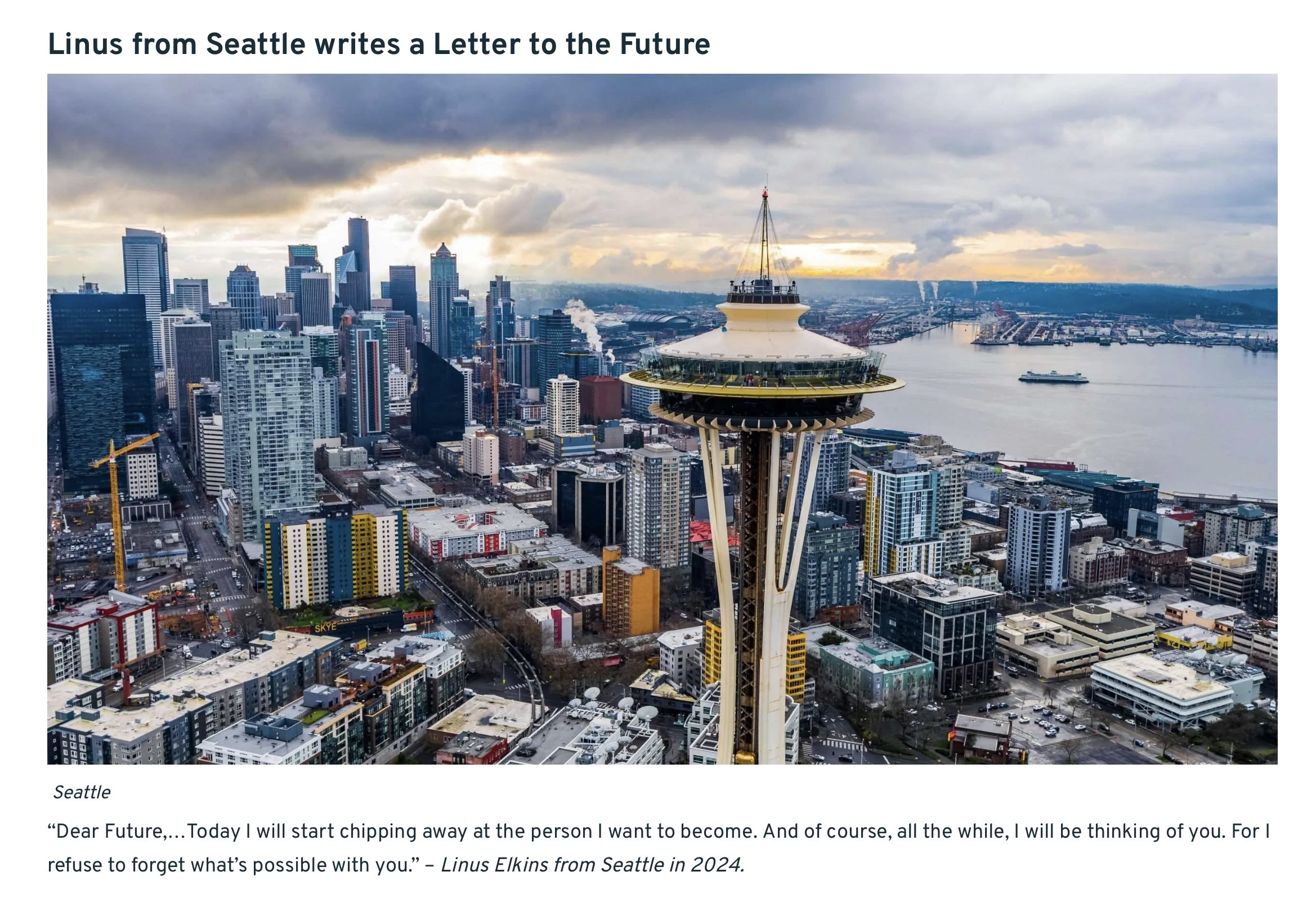
An aerial view of Seattle's skyline.

Courtesy of Nottingham City of Literature

Another fantastic initiative of the Creative Cities Network was the “Letters to the Future” project, which included young writers from 11 Creative Cities to craft messages that speak directly to future generations. Check out this excerpt from Linus in Seattle, (courtesy of Nottingham City of Literature) and check out the link to read more letters from the young writers of the Creative Cities!

A person with long dark hair and wearing a red and gold patterned top looks off to the side of the frame while smiling.

Toa Ghatak


This month, Seattle City of Literature is highlighting UNESCO Sustainable Development Goal #11: Making Cities Safe, Sustainable, Resilient, and Inclusive. We asked a young writer named Toa Ghatak, a 17 year old senior in high school, to share her her thoughts  about the connection between literature and sustainable development goal (SDG) #11. Toa wrote a lovely lyric essay on the topic, which you can read on our website here!

“Literature and humanities must work in tandem with the focus on STEM in our world to be able to make cities and human settlements inclusive, safe, resilient, and sustainable. ”
— Toa Ghatak
/

More Residency Opportunities!

Do you dream of having an opportunity to work on your latest project in one of our sister Cities of Literature? Now is your opportunity to apply for a residency! Learn more below.


Nanjing, China


A birds-eye view of Nanjing, China


The 2024 program is offering 6 residencies to writers, poets and translators from all UNESCO Cities of Literature, for a 2-week stay in Nanjing.


Bremen, Germany (Virtual Residency)

In order to promote literature in digital media, the Bremer Literaturhaus [virt.] e.V., with the support of the Senator for Culture, awards the Bremen Netzresidenz every two years as a three-month online scholarship at the virtual Literaturhaus Bremen.


Tartu, Estonia


Tartu University


Tartu City of Literature is offering a call for applications for a residency in November and December 2024. One writer will be selected.

 
/

Residency Opportunities!

Do you dream of having an opportunity to work on your latest project this fall in one of our sister Cities of Literature? Now is your opportunity to apply for a residency! Learn more below.


Wonju, South Korea

Toji Cultural Center, a white building with a red roof, sits nestled on a green hillside. A field of white flowers is in the foreground.

Toji Cultural Center, Wonju, South Korea

Wonju City of Literature is offering a chance for one writer from a City of Literature to come to Wonju and stay at Toji Cultural Centre for eight weeks in October and November 2024.


Reykjavík, Iceland

Grondal's House is a square red building with lots of windows set in Reykjavík's Old Town.

Grondal’s House, Reykjavík, Iceland

In 2024 the Residency Program in Reykjavík will offer the writer a two-week stay in October 2024. The Program is dedicated to all emerging writers, and poets having at least one published book working currently on a writing. The Residency Program is a perfect opportunity to professionalize writing skills, find the optimal conditions for creative work, and present your own writing to a new audience.


Granada, Spain

A courtyard at the Corrala de Santiago shows a mutlilevel balcony around a central courtyard with green plants.

Corrala de Santiago, Granada, Spain

Granada UNESCO City of Literature and the University of Granada are hosting an international residency in November 2024 to foster contacts and connections between literary authors from Granada and those from different cities and countries of the world; to promote the internationalization of literary authors linked to Granada; to foster the internationalization of the cultural fabric of the city of Granada; and to promote Granada as a cultural city and a city that welcomes international creative talent.

 
/

The Business of Books Resources

 
A banner reading The Business of Books: A Workshop for BIPOC Literary Entrepreneurs is superimposed over an image of bright, well-lit bookstore shelves.
 

This fall Seattle City of Literature hosted three workshops in a series titled “The Business of Books.” The series was created with community to offer resources, build skills and connections for BIPOC (Black, Indigenous, People of Color) literary entrepreneurs.
The series was created and presented in partnership with African American Writers’ Association, Business Impact Northwest, Hugo House, Indigenous People’s Institute, Langston Seattle, Pacific Northwest Booksellers Association, Seattle City of Literature, Seattle Credit Union, The Seattle Public Library “Library to Business” Program, Seattle Office of Economic Development, Seattle Urban Book Expo.

Thank You to Our Panelists

 We’re grateful to the panelists who shared their expertise throughout the series.

September 22:
Gary Luke, former publisher Sasquatch Books
Karen Maeda Allman, formerly of Elliott Bay Book Company
Jeffrey Cheatham II, Seattle Urban Book Expo
Christina Vega, Blue Cactus Press

October 8:
Susan Perrault, Business Impact Northwest
Michael Wells, Seattle Office of Economic Development Small Business Advocate
Stephanie Lachman, Craft3
Kalani Kapahua, Third Place Books
Edwin Lindo, Estelita’s Library
Jay Lyman, The Seattle Public Library

December 6:
Taj Benford, Seattle Credit Union
Robert Williams, Rainier Valley Community Development Fund
Kristina Clark, Loving Room Books
Jay Lyman, The Seattle Public Library
Angela Garbes, author Essential Labor
Joyce Chen, The Seventh Wave Magazine
Marcus Harrison Green, author Readying to Rise


Resources from the Workshops

Library to Business Resources
The Seattle Public Library “Library to Business” program gives you free access to valuable research and databases that provide information about competitors, customers, market trends and more. Attend an event to connect with experts, learn about tools or meet with a business librarian.
Business and Nonprofit
How to Start Your Business

Financial Resources
These are just a few organizations and institutions that offer small business support.
Business Impact Northwest  
Craft3
Rainier Valley Community Development Fund
Seattle Credit Union
Seattle Office of Economic Development

Resources For Writers
A few of the resources for writers that were discussed.
African American Writers’ Alliance
Clarion West Writers Workshop
Hugo House
Kweli Journal
La Sala
Roots Words Wounds
Seattle Escribe
Seattle City of Literature Community Catalog
Seattle Urban Book Expo

Resources For Booksellers and Publishers
A few of the resources for booksellers and publishers that were discussed.
American Booksellers Association
Bookstore Training Group
Pacific Northwest Booksellers Association
Seattle Urban Book Expo

Thanks to 4Culture, The Seattle Public Library, the Gary and Connie Kunis Foundation, The Seattle Times, and The Seattle Public Library Foundation for their support of the series.


/

Help us tell the story of Seattle's stories!

 
Aerial view of Seattle

Photo by Ryan Wilson on Unsplash


You know that Seattle is made of stories—that’s one of the reasons we’re a UNESCO City of Literature. Now it’s time to tell these stories with a literary map of the city.

What people and places do you think should be included?

Some typical examples might be:
- The former residence of a prominent writer
- An event venue that has played an important part in Seattle's literary life
- The location of a deeply significant historical event

We're already considering Seattle's well-known bookstores and libraries, but if you've got a lesser-known suggestion, let us know!

 
Some things to consider as you think of suggestions:

- What has been the long-term impact on the community?
- What has been the long-term impact on Seattle’s profile as a literary city and/or the regional literary scene?
- If suggesting an author, did they reside in Seattle for substantial amount of time? ( In order to keep the list manageable, we’re only considering deceased authors at this time.) 


More Information About the Literary Map Project

 
Image of a paper map of Seattle from Kroll  Map Co. hanging from wooden rod.

Photo by Jay Heike on Unsplash


Community Listening

After extensive interviews with other map creators in our fellow Cities of Literature, in early 2020, Seattle City of Literature convened a group of stakeholders to provide input on people and places to be included in the map. Over the course of several meetings we compiled a preliminary list which you can see here.

We’re grateful for the input of these individuals and organizations:

Frank Abe, Author
Iisaaksiichaa Ross Braine, University of Washington
Jim Cantú, El Centro de la Raza
Claudia Castro Luna, Author
Jill LaPointe, Lushootseed Research
Tim Lennon, LANGSTON
Jolene Haas, The Duwamish Tribe
Elisheba Johnson and Inye Wokoma, Wa Na Wari
Stephanie Johnson-Toliver, Black Heritage Society of Washington
Rosemary Jones, The National Nordic Museum
Karen Maeda Allman, Elliott Bay Book Company
Miguel Maestes, El Centro de la Raza
Christina Roberts, Indigenous Peoples Institute, Seattle University
Jazmyn Scott, Arte Noir

Several additional organizations have agreed to review the map throughout the development process, and we’ll keep updating our contributors list to reflect their input

Format

The map will be made available in both print and digital editions. Due to the constraints of the form, the printed map may include fewer points of interest than the digital.

The People Behind the Map

Designer: Erin Shigaki/Purple Gate Designs

Erin Shigaki was born and raised in Seattle, WA, where she recently returned after many years on the east coast, studying and working in design and art education. Her homecoming has paved a path for public art commissions and grants to create work that is community based and focused on the experiences of communities of color, often the World War II incarceration of her community. Erin is passionate about highlighting similarities between that history, the inhumane detention and family separation immigrants face today, and other systemic violence and injustices black and brown people continue to face. She is keen to explore intergenerational trauma and the emergence of beauty and intimacy despite harsh circumstances. Erin’s work also examines the act of reclamation: of land, language and culture. She believes that using art to tell stories about these moments can educate, redress wrongs, and incrementally heal.

Erin is a community activist, and helps run an annual pilgrimage to Minidoka, the American concentration camp where her family was incarcerated. She is also a part of Tsuru for Solidarity, a nonviolent, direct action project of Japanese American social justice advocates working to end detention and incarceration for all.

Erin holds a B.A. from Yale University and completed additional design and art study at American University and in Brissago, Switzerland, among others. She has exhibited in Seattle, WA at such places as The Wing Luke Museum, Occidental Park, Nihonmachi Alley, Cornish Playhouse, and ARTS at King Street Station. She was a 2018 Artist in Residence at Densho.

Learn more: https://www.purplegatedesign.com/about/

Cartographer: Gregory T. Woolston

Gregory is a graduate student in the Sociology Department at the University of California, Santa Cruz, where he researches relationships between architectural, cartographic, and urban design and racism, as well as social movements working toward spatial justice. He is also a cartographer with a few prints for sale and available for hire.

Learn more: http://gwoolston.me/

Projected Timeline (subject to change):

February 2022: Request community input
December 2022: Draft of Print Map Complete
January 2023: Community Review
February 2023: Print Maps Complete
March 2023: Digital Map Complete

/